Occupancy Estimation from Accesses and Dwell Time
Description
Provides a real-time occupancy estimation based on access counts and dwell time, without requiring full camera coverage inside the space.
This indicator is especially suitable for large or complex environments (for example, shopping malls) and for scenarios where only access cameras are available.
| Element | Detail |
|---|---|
| Description | Estimates space occupancy by combining visitor flow with dwell time. |
| Algorithm | 1. Detects people entering the location. 2. Calculates visitor dwell time. 3. Combines entries and dwell time using a statistical model to estimate occupancy. 4. Produces a stable occupancy metric that is invariant to accumulated error. |
| Key parameters | • Access perimeter • Re-ID window (for dwell time) • Calculation time window |
| Accuracy | High long-term stability. Robust metric against partial data loss and counting errors. |
| Typical use cases | • Shopping malls with multiple access points • Large venues without full internal camera coverage • Crowd monitoring in open or semi-open spaces |
Indicator Principles
This is a derived indicator, built from:
- Visitor detection (entries)
- Dwell time detection
Unlike traditional approaches based on
occupancy = entries − exits, this method:
- Avoids cumulative errors over time
- Does not rely on perfect exit detection
- Produces a consistent, error-invariant metric
- Remains stable even in high-traffic scenarios
Calculation Methodology
- The flow of people entering through all access points is counted.
- The average dwell time of visitors in the location is calculated.
- An algorithm combines both indicators to estimate how many people are simultaneously inside the space.
- The resulting occupancy is updated continuously and remains stable over time.
This approach enables a realistic occupancy estimation, even when internal cameras are not available.
Visual Explanation
The visual explanation uses the same pictograms as the Dwell Time Detection document, adapting the final step to the estimated occupancy calculation.
| Visual explanation | 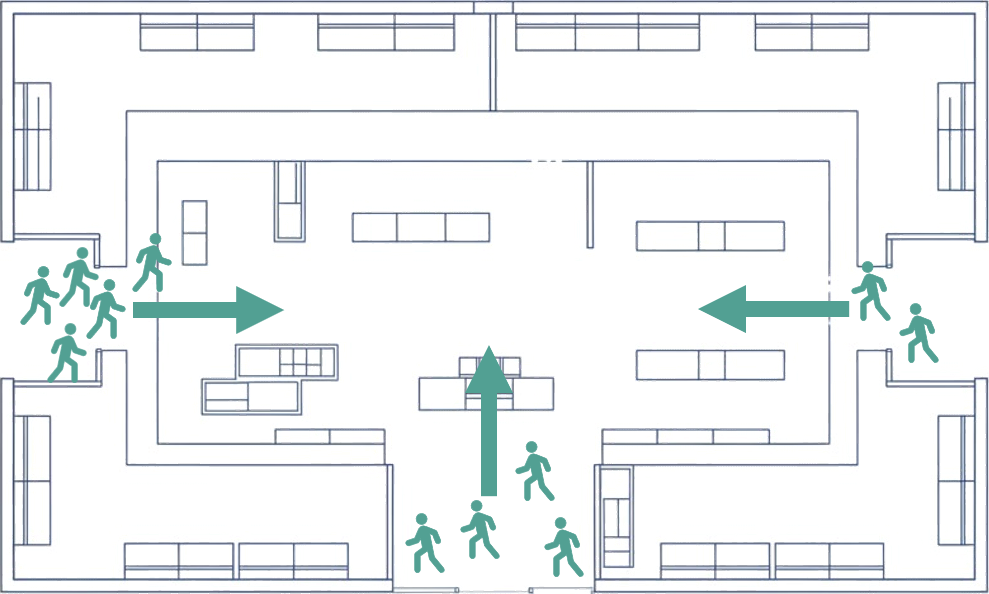 | 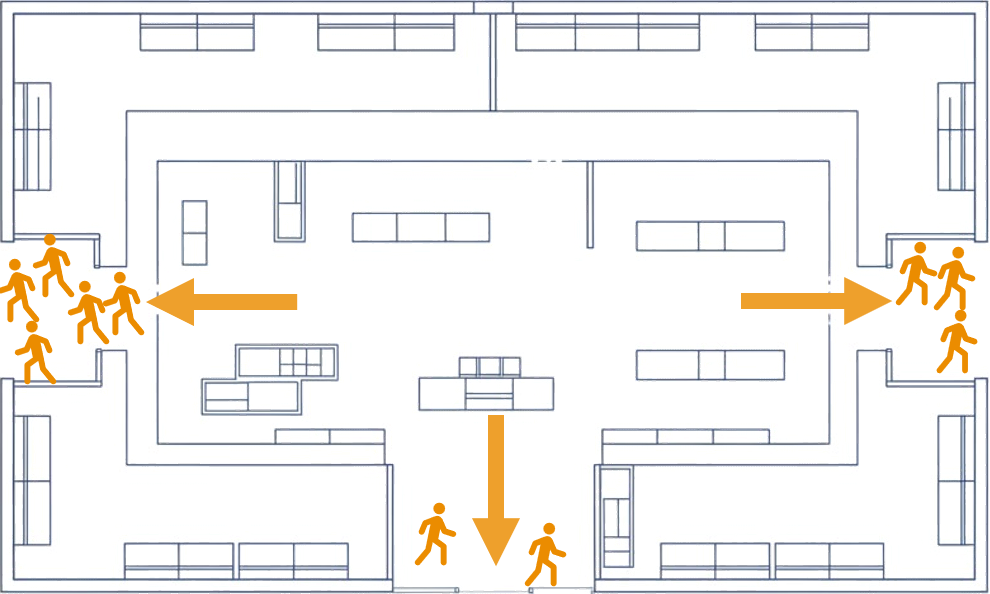 | 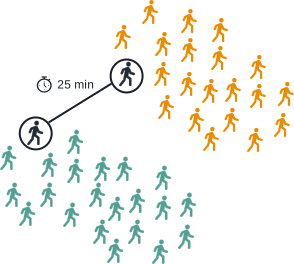 |
|---|---|---|---|
| Description | 1. Entry detection: people entering through access points are detected. | 2. Dwell time calculation: people are re-identified and their dwell time is calculated. | 3. Occupancy estimation: entries and dwell time are combined to estimate space occupancy in a stable and consistent way. |
Important Considerations
Note
- This indicator does not require full camera coverage.
- It is ideal for locations with multiple access points.
- Estimated occupancy represents a statistical measure, not a direct point-by-point count.
- Indicator quality depends on accurate access detection and stable dwell time estimation.